Saturday, March 25, 2017

Stopping By the Woods on a Snowy Evening

Whose woods these are I think I know.     His house is in the village though;
He will not see me stopping here
To watch his woods fill up with snow.

My little horse must think it queer
To stop without a farmhouse near
Between the woods and frozen lake
The darkest evening of the year.

He gives his harness bells a shake
To ask if there is some mistake.
The only other sound’s the sweep
Of easy wind and downy flake.
The woods are lovely, dark and deep,
But I have promises to keep,
And miles to go before I sleep,
And miles to go before I sleep. 

Wednesday, February 8, 2017

Do You Know Aslan?

…said Eustace, “But who is Aslan? Do you know him?”
“Well- he knows me,” said Edmund…
-The Voyage of the Dawn Treader

Why does Edmund say that Aslan knows him but he doesn’t know Aslan? The Chronicles of Narnia are an allegory for parts of the Bible, and it is most pronounced in The Lion the Witch and the Wardrobe. Aslan represents Jesus, the stone table represents the cross where Jesus/Aslan died. You
get the point. Eustace meets Aslan when he is a dragon, and Aslan helps him turn back into a boy.

I think I can make a comparison with the Bible in what Edmund says. Edmund says that Aslan knows him, but he doesn't say that he knows Aslan. God knows everyone. He created everyone, but the lines get fuzzy when it come to you knowing God.

For instance, I believe that there is a God, that there is only one God, but I wouldn’t say that I know God. I would say that I know there is a god, but do I know God as a person, as a being? Not really. God has no beginning and no end, God is eternal, God is creator of Heaven and Earth, and humans don’t really have the ability to comprehend that. I think this is what C. S. Lewis is getting at in this piece of the story. That’s why Edmund says that Aslan knows him, but Edmund doesn't really know Aslan.

By Aurora J. A. Pass

Thursday, February 2, 2017

C. S. Lewis and the Voyage of the Dawn Treader

Clive Staples Lewis was born on November 29, 1898 in Belfast, Ireland. C. S. Lewis is a writer, poet, and author of the popular book series, "The Chronicles of Narnia." He was best friends with J. R. R. Tolkien, and they both worked at Oxford University.

C. S. Lewis and his scholarly friends formed a sort of literary analysis group called the Inklings. The people who attended were J. R. R. Tolkien, Nevill Coghill, Lord David Cecil, Charles Williams, Owen Barfield, and Warren Lewis. C. S. Lewis married Joy Davidman in 1956. He died on the 22 of November, 1963.

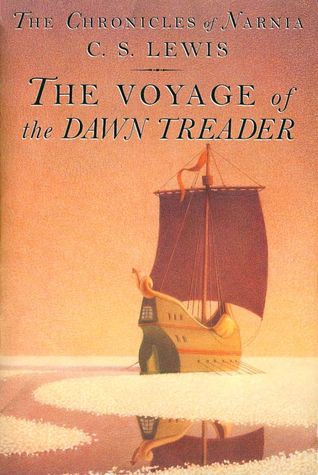
While he was alive, C. S. Lewis wrote the Chronicles of Narnia. One of those is The Voyage of the Dawn Treader, published in 1952. The first edition of The Voyage of the Dawn Treader had 223 pages, which I think is cool to know. The US edition of the book has 52,038 words. It was the third book to published in the seven book series, though the order in which people chose to read the Chronicles varies. It is the fifth book chronologically in the story. So, some people chose to read it in that order. I haven't read all the books yet, and therefore I don't have an opinion on what order they go in yet.
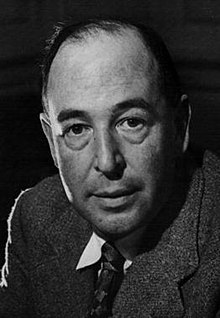
Monochrome head-and-left-shoulder photo portrait of 50-year-old LewisImage result for voyage of the dawn treader

Sources:
  • "The Voyage of the Dawn Treader." Wikipedia. Wikimedia Foundation <https://en.wikipedia.org/wiki/The_Voyage_of_the_Dawn_Treader>.
  • "C. S. Lewis." Wikipedia. Wikimedia Foundation <https://en.wikipedia.org/wiki/C._S._Lewis>.
By Aurora J. A. Pass

Thursday, January 26, 2017

Dr. Seuss

Theodor Seuss Geisel was a cartoonist, writer, and animator. He is best known for writing and illustrating children's books, and he is most widely known by his pen name, Dr. Seuss, which he adopted during his university studies at Dartmouth College and the University of Oxford. Over his lifetime, he wrote a few of the most popular children's book ever.

Born in March of 1904, Geisel left Oxford in 1927 and worked for Vanity Fair, Life, and various other publications, as an illustrator and cartoonist. He was married twice. He married Helen Geisel in 1927 . She died in 1967, and he married Audrey Dimond in 1968.
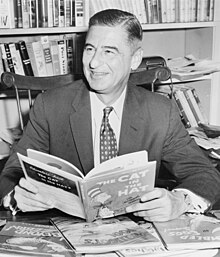
Ted Geisel NYWTS 2 crop.jpg
Photo taken in 1957
Dr. Seuss’s best-selling book is “Green Eggs and Ham” published in 1960, with 8,143,088 copies sold by 2001. “The Cat in the Hat”, published in 1957, is his second best-selling book, with 7,220,982 copies sold by 2001. The third best-selling Dr. Seuss book is“One Fish, Two Fish, Red Fish, Blue Fish”, which was published in 1960, and sold 6,164,454 copies sold by 2001. “Oh the Places You’ll Go” was published in 1991 and was the most rapid selling of all Dr. Seuss’s books and came in fifth on the list of his best-selling books. It is also one of my favorites.

Dr. Seuss died in 1991. Four years later, University of California’s library building was renamed Geisel Library in honor of him.

Dr. Seuss wrote most of his books in Anapestic tetrameter. Usually each line in Anapestic tetrameter is made up of four anapestic metrical feet, and each of these has two unstressed syllables and then a stressed syllable. Many poets and writers believe it is a reason that Dr. Seuss’s books were such crowd-pleasers. I think another reason for the success of Dr. Seuss’s books is his bright and fun drawings.

Dr. Seuss’s stories are funny, and it’s fun to read things that rhyme. His artwork is colorful and eye-catching. The things in his drawings are usually droopy and rounded, giving him his very own style. You can usually compare the objects in his drawings to ones in real life, but he gives them their own bent and drooping look. His characters are usually rounded and sometimes furry, and his animals and creatures are often much bigger or smaller than usual, with added legs and other adaptations.

So many people love Dr. Seuss’s stories, and they are still told to children all the time. I think these unique and exciting books will continue to be read for a long time to come. I will certainly always have little bits and pieces stuck in my head, such as “I do not like green eggs and ham. I do not like them Sam-I-Am.”


Bibliography:

  • "Top 10 Highest Selling Dr. Seuss Books." #AmReading, www.amreading.com/2016/07/02/top-10-highest-selling-dr-seuss-books
  • "Dr. Seuss." Wikimedia Foundation, <https://en.wikipedia.org/wiki/Dr._Seuss>.
By Aurora J. A. Pass

Tuesday, January 24, 2017

Pirates of Penzance

The Pirates of Penzance is a musical, a comedy, and a romance. It is also known as “The Slave of Duty”. Arthur Sullivan wrote the music for the play with the help of W. S. Gilbert working on vocals.

The musical was first performed December 31, 1879 at the Fifth Avenue Theatre in New York. It premiered in London on April 3, 1880, in the Opera Comique. They ran a total of 363 performances at the Opera Comique.

A general synopsis is that a young man named Frederic is apprenticed to a pirate. His father planned to apprentice him to a pilot, but by the mistake of his nurse, Ruth, he ends up apprenticed to a band of pirates known as the Pirates, until his 21st birthday.

Richard Temple as Pirate King in
the first production of The Pirates of Penzance
at the Opéra Comique, London.
Engraving by M. Stretch from
The Illustrated Sporting & Dramatic News,
June 26th 1880
He turns 21 and ventures off on land, planning to kill the pirates if he sees them again, because that's what any respectable gentlemen would do. He sees a group of young maidens when he comes ashore, and sneaks up on them. He falls in love with one of them, Mabel. The pirates sneak up and say that are going to marry all the girls. The girls’ father, the Major General, gets there and tells the pirates to leave his daughters because he is an Orphan and he has no family. The pirates, having a weak spot for orphans, give up and let them go.

Later, at the house of the Major General, the Major General is feeling guilty about lying to the pirates about being an orphan. The police men show up and offer to arrest the pirates. The girls are happy about this and tell them to go and do it.

Frederic sits in the garden alone. Ruth and the Pirate King sneak up on him and tell him that he is still one of them, because he was born on the 29th of February in leap year, and so according to birthdays he's only 5. Frederic tells Mabel, and she pleads for himself to stay, but he leaves, being bound by his sense of duty.

Frederic tells the pirates that the Major General was lying about being an orphan, and they plot to kill him. They go sneaking up to kill him. The pirates leap out to attack, and the police defend the Major General. There is a scuffle and the police eventually win. The police get ready to kill the pirates, but Ruth pleads with them and tells them that the pirates are all “Nobleman who have gone wrong.” The Major General is impressed, and he forgives them. All is forgotten, and Mabel and Frederic are reunited, and the Major General marries his daughters to the Noble Pirates.

As you can see it is a truly hilarious and ridiculously romantic work of art. I liked it because it had a bit of a Pirates of the Caribbean feel to it. The pirates in both stories are tricksters and have ridiculous senses of humor.

Sources:
  • "The Pirates of Penzance." Wikimedia Foundation, https://en.wikipedia.org/wiki/The_Pirates_of_Penzance
  • The Pirates of Penzance. Dir. Wilford Leach. By Wilford Leach and William Elliott. Prod. Joseph Papp. Perf. Kevin Kline, Angela Lansbury, and Linda Ronstadt. Universal Pictures, 1983.
  • Sullivan, Arthur Seymour, and Wilford Schwenck Gilbert. The Pirates of Penzance. New York: A.W. Tams Music Library, n.d. N. pag. Print.
  • "The Pirates of Penzance by W. S. Gilbert and Arthur Sullivan." Gilbert and Sullivan Archive, http://gsarchive.net/pirates/html/
By Aurora J. A. Pass

Thursday, December 22, 2016

Living Without Plastic

I just wanted to share these websites with anyone out there who's listening. I have been trying my best to not use plastic, that I know will eventually end up in the Ocean. Here are some websites on living without plastic and other people who don't use plastic.

The websites:
The Zero-Waist Chef
Life Without Plastic
Plastic Pollution Coalition
The Plastic Pollution Coalition's "No Straw Please" Pledge

Saturday, October 1, 2016

For the Chipmunk in my Backyard

I think he knows I’m alive, having come down
The three steps of the back porch
And given me a good once over. All afternoon
He’s been moving back and forth,
Gathering odd bits of walnut shells and twigs,
While all about him the great fields tumble
To the blades of the thresher. He’s lucky
To be where he is, wild with all that happens.
He’s lucky he’s not one of the shadows
Living in the blond heart of the wheat.
This autumn when trees bolt, dark with the fires
Of starlight, he’ll curl among their roots,
Wanting nothing but the slow burn of matter
On which he fastens like a small, brown flame.

~By Robert Gibb